
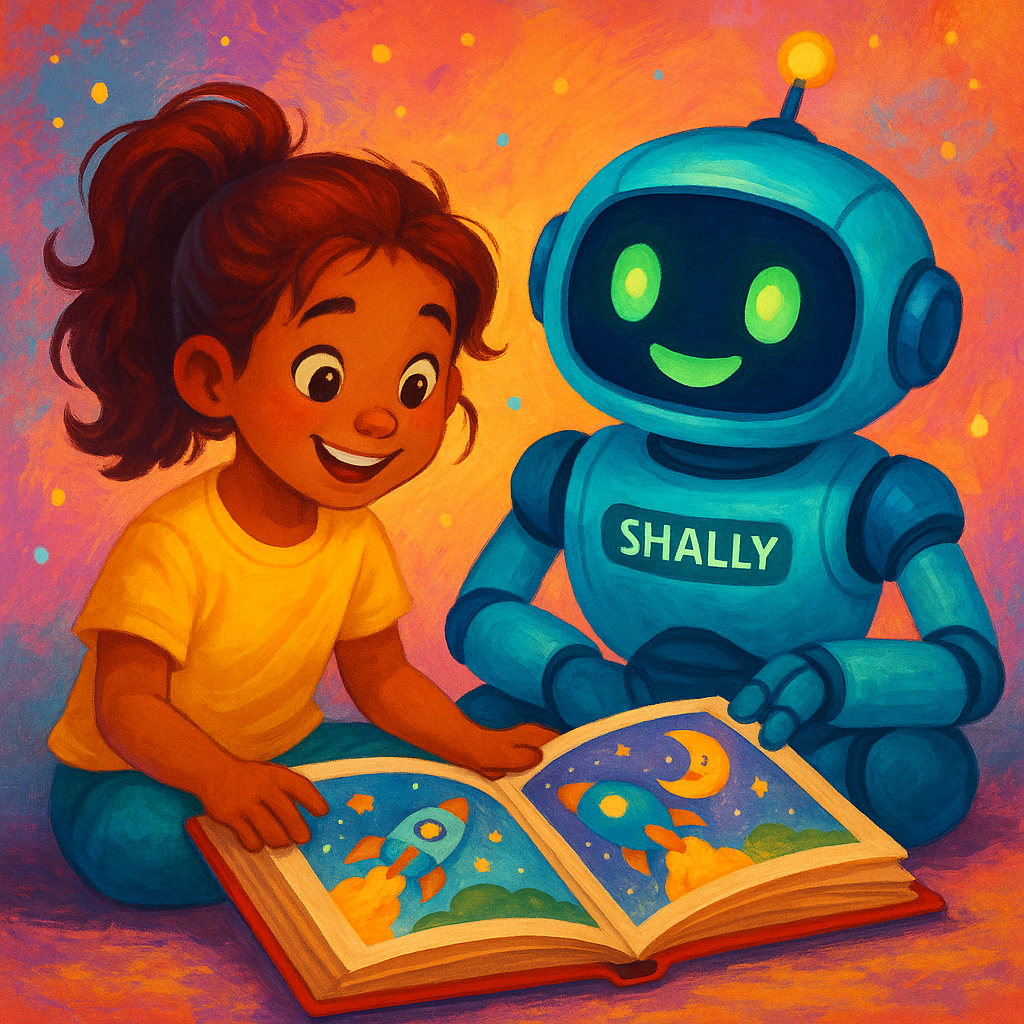
It begins with a voice, a quiet bedtime moment.
A parent and a child sit together, the soft glow of a tablet lighting the room, not to play another cartoon but to create a world together. The screen isn't a distraction this time. It's a doorway.
Inside that doorway lives Shally, an AI storyteller that listens, imagines, and builds alongside the child. A simple prompt, a brave fox who can talk to stars, becomes a living fairytale filled with color and sound. The child laughs, suggests a twist, and the story changes instantly. For the first time, the screen answers them, not the other way around.
That moment may seem small, but something profound is happening underneath.
Psychologists describe it as the ability to shape a story, the power to influence what happens instead of just following along. For children, it's more than fun; it's a way to practice empathy, creativity, and self-expression. Every decision they make inside a story — to help, to explore, to imagine — becomes practice for the decisions they will make in life.
In traditional storytelling, the parent reads and the child listens.
In this new form, the child participates and the parent co-creates.
This simple shift changes everything. It teaches children that their ideas matter. It builds confidence, language, and curiosity while deepening the bond with the person beside them.
With Shally, technology stops telling children stories and starts listening to them. The AI adapts to mood, age, and tone, creating experiences that feel personal rather than mechanical. It remembers that one child loves dragons, another prefers gentle creatures, and a third always asks for a happy ending. Instead of forcing the child to fit the story, Shally shapes the story to fit the child.
And in that process, something remarkable happens.
The boundary between learning and play disappears.
Children begin to express complex emotions like fear, joy, courage, and friendship through the characters they help create. They find their own voice inside the voice of a hero. They learn emotional intelligence without realizing they are learning at all.
Parents rediscover the beauty of storytelling. They no longer compete with screens for attention. They join the adventure. Together they laugh, invent, and dream. A story becomes a shared space, a language of imagination that connects generations.
When the tale ends, there is no "Game Over." There is pride and ownership. The child looks at what they have created and says, I made that. That is not just creativity; it is confidence being born in real time.
Technology has changed childhood, but in the right hands it can also enrich it.
Artificial intelligence doesn't have to replace wonder; it can amplify it.
And maybe, years from now, when that child grows up and tells their own stories, not with an app but from memory, they will remember the night the stars spoke back and their imagination learned to fly.