
 Back to Blog
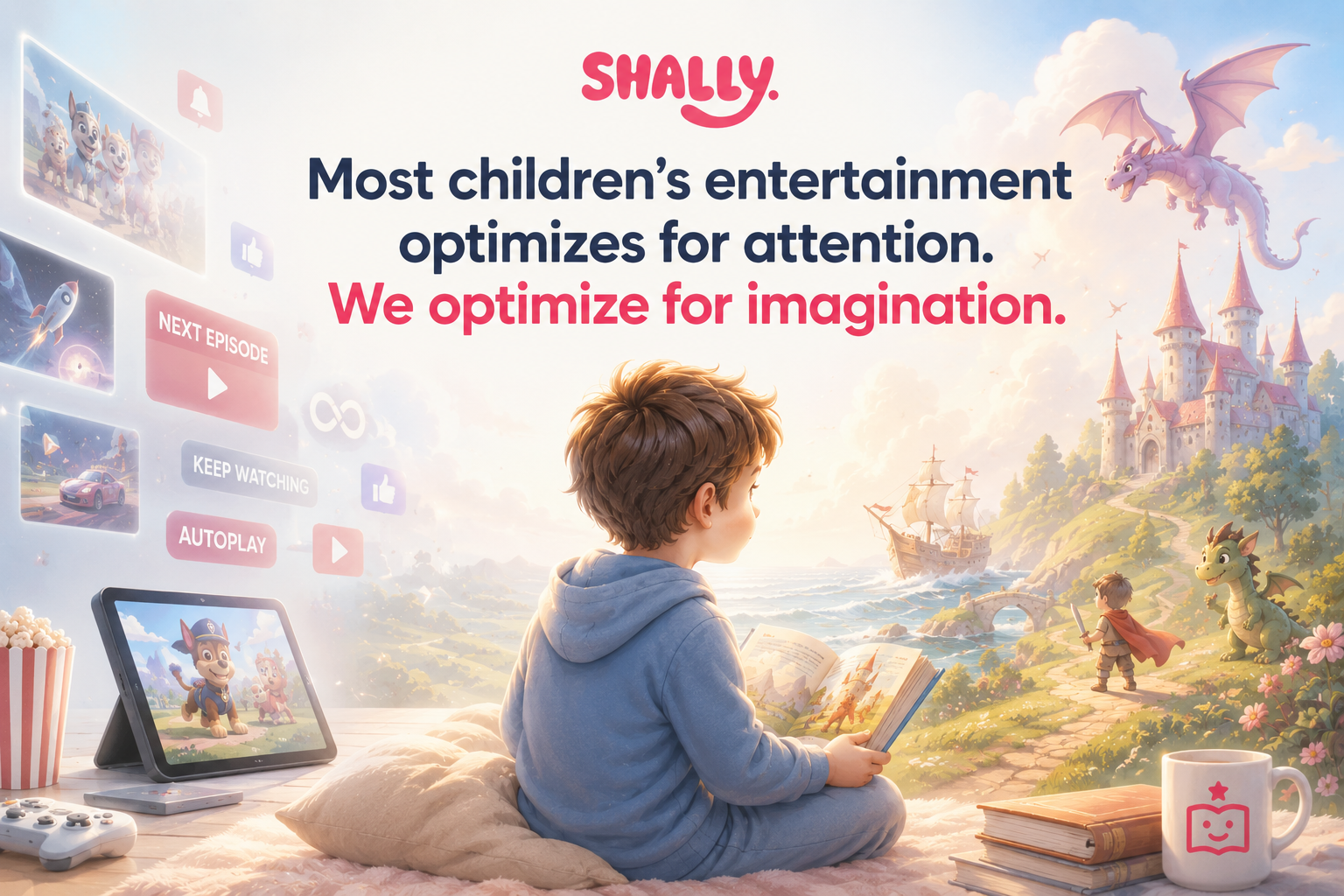
Most Children's Entertainment Optimizes for Attention.
The children's entertainment industry has spent years perfecting one thing: keeping kids watching. At Shally, we believe technology should help children imagine instead.
Somewhere along the way, children's entertainment changed.
It stopped competing to tell better stories.
It started competing for attention.
Today, every streaming platform, recommendation algorithm, autoplay feature, and endless content library is measured by the same question:
How long can we keep children watching?
That's not because the people making children's content are bad.
It's because attention has become the most valuable currency on the internet.
The longer children stay engaged, the more successful the platform becomes.
From a business perspective, it makes perfect sense.
From a childhood perspective, we're not so sure.
The Attention Economy Has Reached Childhood
Every generation has worried about the next form of entertainment.
Television.
Video games.
The internet.
Today, we have something entirely different.
Children no longer simply watch cartoons.
They enter platforms designed to never let the next story end.
One episode becomes another.
Recommendations never stop.
The next adventure starts before the previous one has had time to settle.
The goal isn't necessarily to tell the best story.
The goal is to make sure children press—or don't even need to press—Play again.
This is what happens when storytelling becomes part of the attention economy.
Stories Were Never Meant to Be Endless
The greatest stories in history all have something in common.
They end.
The book closes.
The hero returns home.
The adventure is over.
And that's exactly when something remarkable begins.
The child starts imagining.
"What happened next?"
"What would I do?"
"What if I were there?"
That quiet moment after a story is often as valuable as the story itself.
Imagination needs space.
Curiosity needs silence.
Wonder doesn't grow when every empty second is immediately filled with another episode.
Watching Is Passive. Imagining Is Active.
Imagine a dragon.
Not one from a movie.
Your own dragon.
What color is it?
How big are its wings?
Does it breathe fire?
Is it frightening...
or friendly?
Every child reading these questions imagines a different dragon.
That is the magic of storytelling.
When everything is already animated, voiced, designed, and visualized, children receive someone else's imagination.
When they read—or listen to—a story, they build the world themselves.
The castle.
The forest.
The hero.
The monster.
Every detail becomes an act of creation.
Stories don't just entertain children.
They invite children to participate.
Technology Isn't the Problem
It's easy to blame screens.
We don't.
Screens are just tools.
The same tablet that can autoplay videos for hours can also introduce a child to books, stories, languages, music, art, and creativity.
The question has never been:
"Should children use screens?"
The better question is:
"What should they experience while using them?"
We don't believe the future is screen-free.
We believe the future should be imagination-first.
Why We Built Shally
Shally didn't begin as an AI project.
It began with a simple observation.
Children still love stories.
Parents still love reading with their children.
But finding fresh, meaningful stories—and competing with endless passive entertainment—has become harder than ever.
At the same time, artificial intelligence made something possible that had never existed before.
Stories could become personal.
A child could become the hero.
A favorite toy could become a sidekick.
A bedtime story could be completely new every night while still carrying the same values parents want to pass on.
For us, AI wasn't an opportunity to replace storytelling.
It was an opportunity to bring storytelling back.
We Optimize for Imagination
Every technology company optimizes something.
Performance.
Engagement.
Retention.
Watch time.
At Shally, we optimize for something different.
Imagination.
Every product decision starts with the same question:
"Will this make a child imagine more?"
Will this encourage curiosity?
Will this make reading exciting?
Will this inspire questions instead of endless scrolling?
Will this become a story a family remembers together?
If the answer is no, it doesn't belong in Shally.
A Different Future for Screen Time
We don't believe parents are looking for more content.
There is already more content than any child could consume in a lifetime.
What families need is better content.
Stories worth remembering.
Stories worth discussing.
Stories that encourage children to think instead of simply continue watching.
We're not trying to win the battle for more screen time.
We're trying to change what screen time means.
Our Mission
Most children's entertainment optimizes for attention.
We optimize for imagination.
We believe every child deserves stories that spark curiosity instead of endless consumption.
Stories that invite participation instead of passive watching.
Stories that make children creators inside their own minds.
That's the future we're building.
One story at a time.